Peptides Emporium catalogue of borrowed results
A promising result can survive its full ingredient list. I want the credit to go to the substance actually tested. Some of the most interesting entries here have been given the wrong name.

The hair trial and its extra ingredient
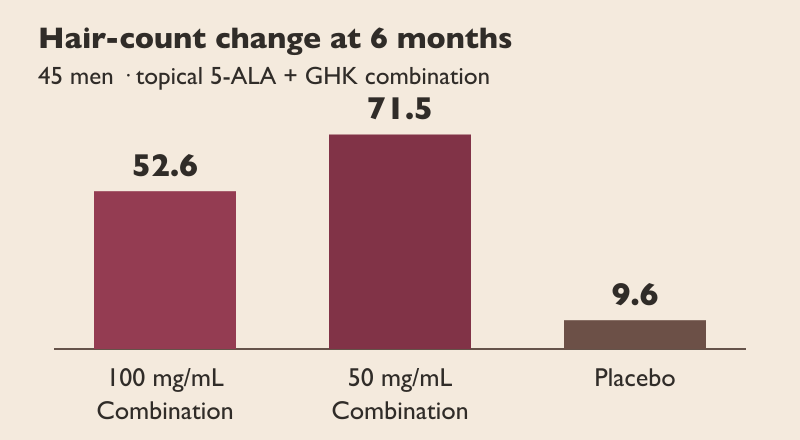
In a 6-month trial of 45 men with androgenetic alopecia, a topical complex containing 5-aminolevulinic acid and GHK increased hair counts compared with placebo. A proper human trial, a measurable change, a reason for interest. Then comes the ingredient that disappears from the retelling: 5-aminolevulinic acid. The formulation contained both substances. The experiment cannot divide the credit between them, or establish what GHK-Cu alone would have done.
I initially filed this as a copper-peptide hair trial. The full formulation persuaded me to move it. That small act of reclassification turned out to be more useful than another list of peptide benefits.
An emporium gathers unlike things under one roof. Here the collection is Melanotan II and GHK-Cu, and the trouble starts when an interesting result gets shelved under the nearest familiar name. There is plenty worth examining once each finding has its own place.
Copper in a piece of skin
The skin-penetration experiment offers a second example. It applied a copper tripeptide to human skin outside the body and measured copper moving through, or remaining in, different skin preparations. Those copper measurements are valuable. Their subject is more specific than the phrase “the peptide gets through skin” suggests.
That distinction changes the next question. How much intact complex reaches a useful location, in which formulation, through which skin barrier? The review of topical GHK delivery makes the barrier problem central to the story. I’m absorbed by that stubborn skin barrier. Another catalogue of cellular effects can wait. The GHK-Cu entry follows the copper, the formulation and the human skin studies.
The melanocortin relatives
Melanotan II has another kind of borrowed reputation: proximity to approved relatives. The history of melanocortin therapeutics traces Melanotan I, cyclic Melanotan II and the further modified compound bremelanotide. The family resemblance helps explain the research. Each compound still has its own clinical record.
Afamelanotide has an approval for erythropoietic protoporphyria; bremelanotide has a separate approval for hypoactive sexual desire disorder in premenopausal women. Melanotan II has no approval from any regulator for any use. Its own small human studies and reported harms deserve their own entry.
I distrust this collection of borrowed credit: a relative’s approval, a mixture’s result and a laboratory mechanism. Put the actual findings beside each other, though, and the differences become fascinating. The comparison is where those differences are easiest to see.